
Gwenyth Fitzpatrick Reflects on "Amazing Opportunity" at Coriglia Excavation Project outside Orvieto, Italy
November 03, 2026
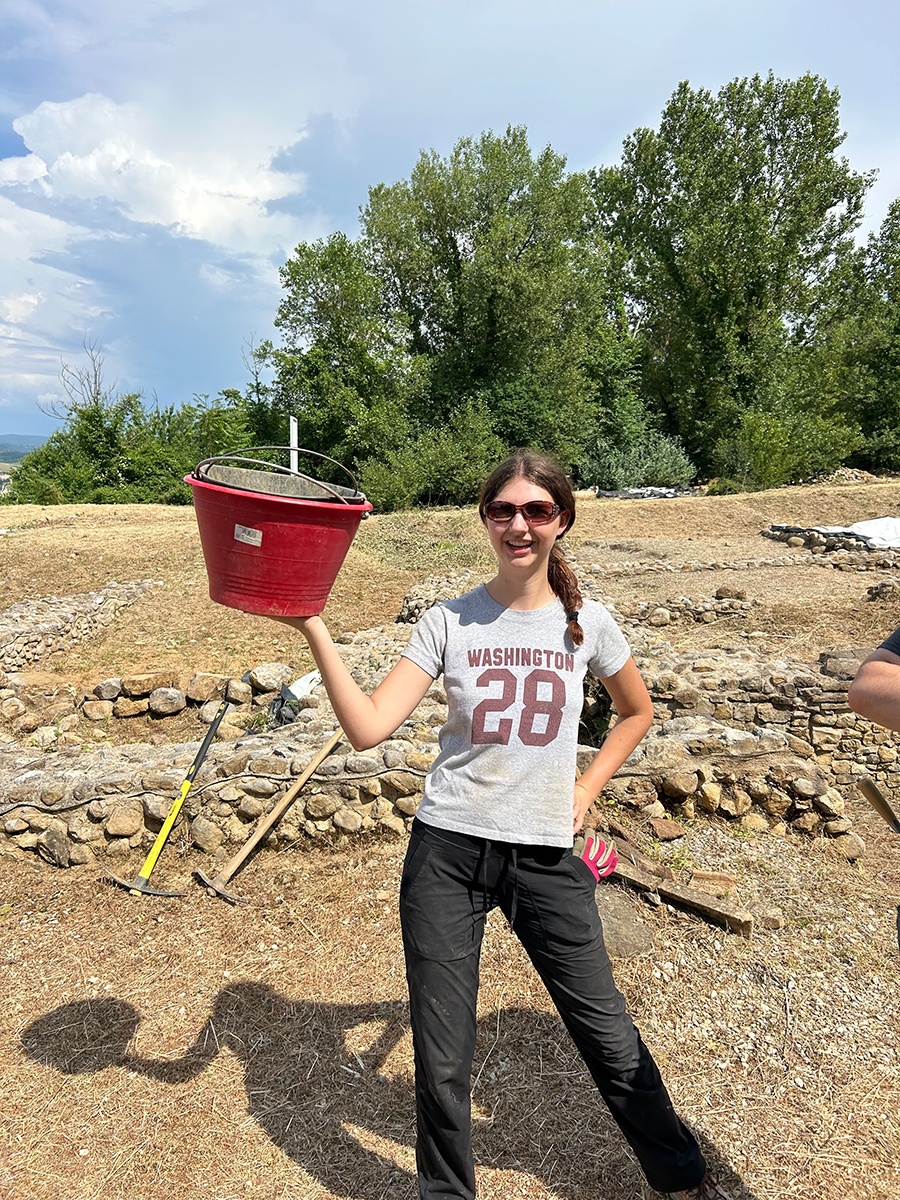
Mark Sandler Undergraduate Experience Award supported Gwenyth's experiences
Gwyneth Fitzpatrick in her own words about her experiences this past summer near Orvieto, Italy:
This summer I had the amazing opportunity to leave the classroom and explore life on an archeological site at the Coriglia Excavation Project. Coriglia is an Etrusco-Roman site located just outside of Orvieto, Italy. The site was continuously inhabited from the Etruscan to Roman era and served as a major stop on the Via Cassia, a trading route heading north from Rome. This past season, my team spent five weeks further uncovering an Etruscan Kiln that was discovered in the previous season. During my time at Coriglia, I learned many skills such as pickaxing, trowelling, articulating, and cleaning and documenting artifacts.
As an Art History & Archeology student at the University of Maryland, this experience was an amazing opportunity to expand my coursework and explore career paths. Working around the kiln, the most common artifacts we discovered were pieces of pottery and tile. Using a pickaxe to move larger rocks and a trowel for more precise articulation, my team produced dozens of buckets each day. We would then have to sort through each bucket before dumping them in order to ensure that no important artifacts or soil characteristics were missed. The artifacts that were kept were carefully managed so we knew exactly which layer they came from. They were then cleaned and catalogued in the lab. Understanding which objects were found in each layer helped us gain insight on which activities took place on site at what time. For example, we found a piece of bucchero, a distinctly Etruscan type of black pottery, that confirmed the kiln was used in the Etruscan period.
In addition to discoveries on site, we were taken on several field trips and had weekends free for trips of our own. These outings helped us grasp the greater context of what activities took place in the area throughout the centuries. For example, on the weekend I took a tour of the vast cave and tunnel network under the city of Orvieto. I learned that many of these tunnels were dug by the Etruscans in order to create more space for olive oil production and ultimately secure water access during sieges. I was also able to travel to Rome and discover many of the artifacts and pieces that I had learned about in my UMD courses. In the Roman Forum, I saw Trajan’s
Column and the Arch of Titus, both of which I had learned about in ARTH 200.
This experience would not have been possible without support from the Professor Mark H. Sandler Endowed Undergraduate Student Experience Award. This scholarship helped me cover program and travel expenses. I am extremely grateful for this experience, as it has helped me build an understanding of my future career goals and aspirations. In the future, I hope to have more hands-on experience working with artifacts and learning about classical archeology!

