
Interrogating Institutional Memory: Trinitee Tatum’s Work as an ARTH Fellow at the Phillips Collection
December 10, 2025
Interrogating Institutional Memory: Trinitee Tatum’s Work as an ARTH Fellow at the Phillips Collection
Located at the intersection of Q and 21st Street in Washington, D.C.’s historic Dupont Circle, the Phillips Collection has served as a cornerstone of modern and contemporary art in the United States for over a century. Founded in 1921 by Duncan Phillips with around 240 works, it has since grown into an internationally recognized museum with a collection of more than 6,000 pieces. Like many early twentieth-century institutions, the Phillips historically collected straight white male artists. In response to industry-wide calls for accountability and diversification in the late 2010s, the museum launched the Institutional History Project (IHP) in 2021 to critically examine its history and organizational identity, alongside establishing my current position as the Makeba Clay Diversity Fellow.
My primary responsibility as a fellow is contributing to the IHP, which investigates the Phillips’ history through a DEAI-informed lens. Building on the work of previous fellows, I focus on artists acquired in the twenty-first century, researching their race, ethnicity, gender, disability status, sexual orientation, and nationality. Using an Excel spreadsheet and the museum’s registrarial records, I have been documenting acquisitions year by year from 2000 onward. Much of this work involves synthesizing secondary sources, but primary materials, especially artist interviews, have become increasingly important for recent acquisitions. Obituaries have been particularly useful for understanding aspects of disability and sexuality not readily visible elsewhere. I have completed documentation through 2010 and am preparing to present my findings to the Board of Trustees’ DEAI Committee in January.
This fellowship opportunity continually engages principles central to my art history training: critical analysis, close reading, and collaborative inquiry. Translating complex and fluid aspects of personal identity into discrete categories is difficult and inherently contradictory. These challenges have prompted meaningful conversations with professors and colleagues about the ethics and limitations of this categorization. What does it mean for a researcher, especially a young scholar as myself, to become an intermediary for another’s identity? What dimensions, such as class or educational background, remain unaccounted for? And how do shifting cultural definitions complicate demographic research across time? Navigating these tensions has been intellectually formative, prompting deeper reflection on what museums record, how they do so, and how the documentation of identity might be approached with greater nuance and care.
Beyond research, I participate in weekly cohort learning sessions led by our supervisor, Shelby Bergstresser, whose curriculum introduces key issues in museum practice, including diversity, censorship, and repatriation. These discussions, along with field trips to other institutions, broaden my understanding of the museum field. Within the Phillips, additional opportunities– from Dr. Adrienne Childs’ lecture on Vivian Browne to conversations with archivists about collection stewardship– have deepened my interest in pursuing a career in art institutions, particularly archives, libraries, and public programs.
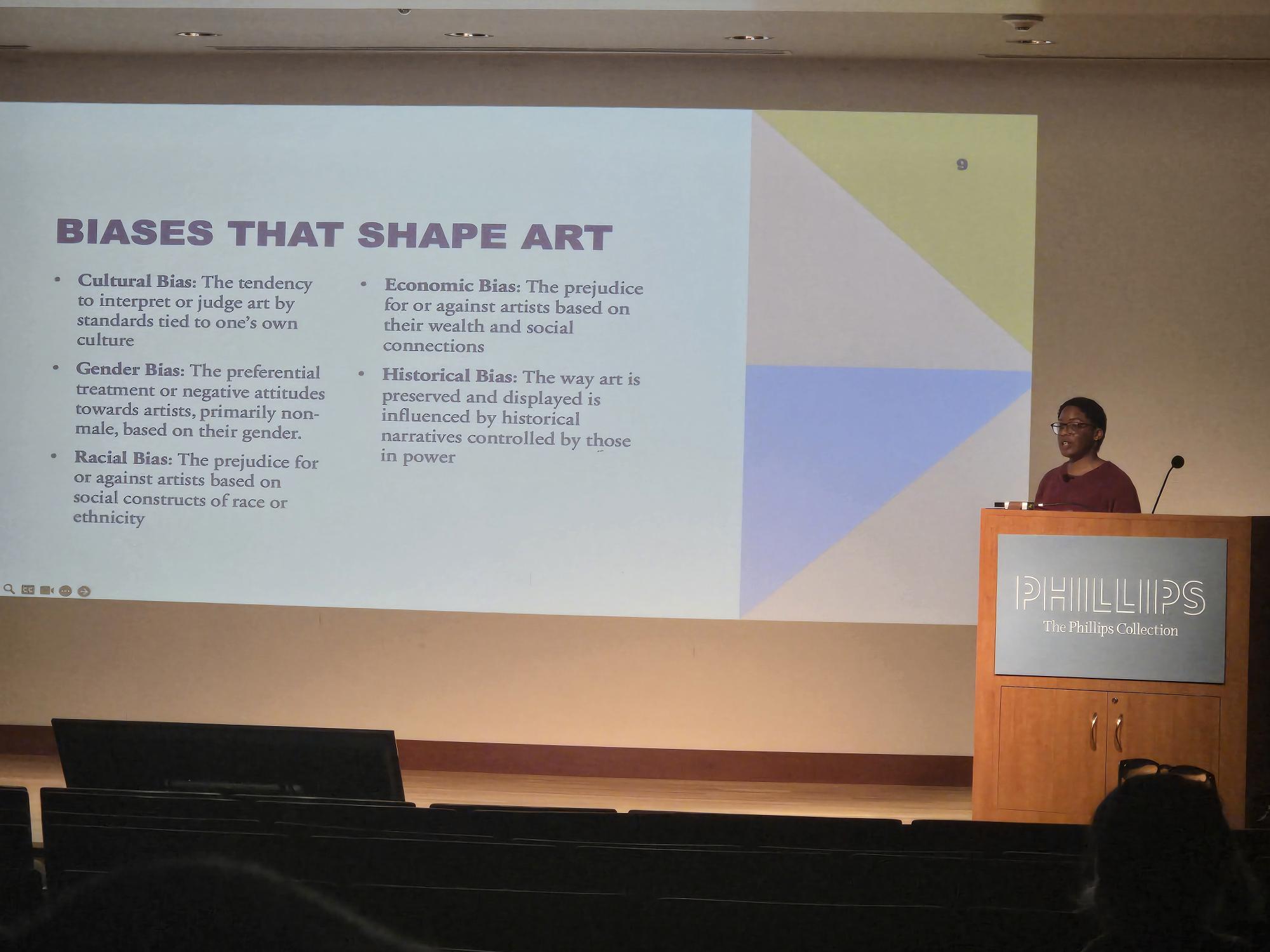
I feel extraordinarily fortunate to hold this fellowship as an undergraduate. The Phillips staff, from museum assistants to senior leadership, have been consistently welcoming and supportive. In the coming weeks, I will present on bias in art for the Diversity Intergroup Dialogue Series, using works from the exhibition Out of Many to explore how museum staff can identify and mitigate bias. These opportunities allow me to see the tangible impact of my research and participate in meaningful change from within the institution.